Thursday, September 18, 2014

Almaden and Vasona Lake Birding

          When we arrived back home from our family trip to Southern California, (nice birds there included lifers Reddish Egret and Least Tern at Bolsa Chica, yearbird Wandering Tattler, and a Great Horned Owl, in broad daylight in Hungington Central Park!) I was only two weeks and a day away from the first day of high school. I would have to see some good birds during this period of time, before crazy homework and projects would start at BASIS. Luckily my cousins were visiting from Chicago at the time, so I got to spend some time with them and visit some local museums and parks.

       On August 6th, my brother, cousins, and I went to Almaden Lake Park with our grandfather. I didn't take my camera - just my binoculars for "pleasure birding." I would try to find any of the warblers that Janna Pauser had recently reported in the willows near the bridge - Yellow and Wilson's would be yearbirds.

        At around 11:00, we parked near the south side of the lake and began our counterclockwise walk to the Coleman Rd. bridge. The best birds were a Western Grebe, a Spotted Sandpiper on the island in the middle of the lake, a Bewick's Wren (there seems to be less of them this year), and around 300 gulls, of which most, if not all, were California. On the way back, I spotted a Green Heron on one of the lake's gravel beaches. In the eucalyptus trees near the pedestrian bridge over Los Alamitos Creek, I found about ten Hooded Orioles, all calling their "wheet" calls! Ten Hooded Orioles is quite a bit - more than I've ever seen in one place. In the willows past the bridge, all I found were more Hooded Orioles. Upon reaching the lawns, we turned, and headed back towards our car.

        I sped up to have more time to check the willows again. This time, I was lucky: as I peered into the undergrowth, I saw a small shape darting around there! Bringing it into my binocular's view, I caught several flashes of yellow - a warbler! After about thirty seconds, the warbler came out into the open to reveal its short bill, olive back and head, and gray undertail, sealing the ID of Wilson's Warbler (the lack of a black cap made it a female)! I was relieved to have finally gotten this yearbird - I had managed to miss it in Monte Bello OSP in the spring, as well as several other places. At one point, I thought I saw another warbler appear for a few seconds in the greenery, (which looked to be a Yellow Warbler), but I decided not to count it because of the bad look I had and the uncertain ID.

        As a bonus, I noticed a single Vaux's Swift flying high above me as I exited the park. Casual birding for the win - I'd seen some better birds in the realxing hour-and-a-half I was there than during some real birding trips!

Summary:
Birds seen: 32
New birds: 1
Big year count: 176


* * *


       The next day, August 7th, I went to Santa Teresa County Park with my cousins and we walked the Mine Trail, and around Pueblo Picnic Area. It was a slow, hot day, with the best birds being Rufous-crowned Sparrows, a Golden Eagle, Band-tailed Pigeons, Steller's Jays, and two Wrentits.

Summary:
Birds seen: 20
New birds: 0
Big year count: 176

* * *


       Vasona Lake County Park is one of our county's best birding spots which could use more popularity with birders. Sitting near downtown Los Gatos on the Los Gatos Creek Trail, it is an amazing place for migrating birds in the fall. Flycatchers, orioles, tanagers, and vireos can all be found there, but its specialty is the warblers. Last year, in the fall, for around three months, there was even a continuously reported Costa's Hummingbird in the sage near the pedestrian bridge. Of course, I got completely frozen chasing it one day in December (the day it decided to fly south and disappear), so I never saw it.

       I started my big year on January 1st in Vasona, seeing lots of nice birds, and saw a Bald Eagle there in February. If you've never visited it, please do: you won't regret it!

       On August 11th, I went to Vasona at around 12:00 with my cousins and grandpa. It was late and rather hot, so I didn't seriously expect to see any good birds. Deciding to "lazy bird" again, I only brought my binoculars. I started birding at the eucalyptus trees that serve as a Great Blue Heron rookery in the spring, but were empty now. About a minute in, I began hearing Chestnut-backed Chickadees in the oak trees around me. I immediately looked up, knowing that migrating warblers like to associate with birds like chickadees and Bushtits in the fall. The first bird that caught my eye, however, was a Brown Creeper! It, too, was associating with the chickadee flock, gleaning the oak bark for insects!

      Soon, a yellow bird came into view, which I knew was a warbler. The lighting was too bad for me to distinguish between Yellow and Orange-crowned, but I tentatively leaned Orange-crowned because of the dusky vest and pointed bill (it was hard to tell). Walking the trail near the Meadowbrook and Creekside Group Areas, the best birds were White-breasted Nuthatches, Band-tailed Pigeons flying over, and Dark-eyed Juncos and Black Phoebes. In the eucalyptus trees on the right side of the trail there were both Hooded and Bullock's Orioles (more of the former), Anna's Hummingbirds, and American Robins. I also heard several calls I didn't know, that I guessed could have been Swainson's Thrushes. I just couldn't get a look at the unknown bird making that call!

         On the way back from the railroad, I checked the "eucalyptus tree side" of the trail again. To my surprise, the first bird I saw was another small, yellow one - this time, it was much lower, and I identified it as a beautiful male Wilson's Warbler with a black cap! Not twenty feet away from it, I found a definite Orange-crowned Warbler which was almost as beautiful.
  
         The best birds on the lake itself was a Green Heron and a Caspian Tern. That ended my first day at Vasona.

Summary:
Birds seen: 34
New birds: 0
Big year count: 176

* * *

       My next trip to Vasona, two days later, went even better. That day, I started a bit earlier - at 10:15, which was a bit less hot, so more birds were out. My cousins wanted to go canoeing and paddleboarding on the lake, so we parked at the parking lot near the playground, and began walking toward the boat dock. Suddenly, I heard unmistakable warbler "chip" calls coming from the island with eucalyptus trees! 

       I quickly turned my binoculars on the action in the greenery, and saw a small yellow, bird disappear into the undergrowth. I noticed two more birds higher up, chasing each other around the leafless branches - my first-of-fall Yellow-rumped Warblers! It's been more than three months since I saw my last, departing one in the spring. Time to get used to the sound of their calls filling parks in the winter!

       Suddenly, I noticed the yellow bird popping back out of the bushes, right near the creek's water! This time, I identified it as a male Yellow Warbler without any doubts - traces of red streaks on its breast, olive wings, and a short tail with yellow under it. I was sure that I would get this bird, but better sooner than later - not to mention the looks were really good! These birds are better in the spring in their fresh plumage, but I could still detect some of the red streaks on its chest.

       Soon, an Orange-crowned Warbler popped out right by the two Yellow-rumps - I actually think I might have seen that bird instead of the Yellow when I initially saw it disappearing into the shrubs. The Orange-crowned completed a warbler trio - three warblers in a day. I've never done four before, but today seemed like a good chance, with Wilson's still possible.

       While my cousins went on the canoe, I walked to the dam and back. The best birds were a Caspian Tern, a Green Heron, a heard only Belted Kingfisher, and a Brown Creeper (!). I was surprised to have found another one, because I've never even seen one here before my last trip. In fact, I first located the creeper by its sharp, high calls, and then found it on the eucalyptus trees near the dam. After that, I joined my cousins on the canoe for about thirty minutes, before heading off toward the eucalyptus trees near Meadowbrook and Creekside Group Areas, hoping to find more good birds.

          I was not disappointed. Well, in the first stand of tall eucalyptus trees, I was. As soon as I got to the riparian area near the Meadowbrook Group Area, I noticed a bird foraging in the lower branches of a tree standing in the meadow. To my great surprise, I found it was a Black-throated Gray Warbler! I saw this county code 3 last year, as well as this year in Montebello in the spring. However, I'd almost never had looks as good as these at any warbler! It was in plain view half of the time, about ten feet off the ground at the lowest. I could easily make out the little yellow lore spots! This warbler was associated with a Chestnut-backed Chickadee flock, and I soon noticed two more interesting birds flying between the trees in the meadow, spiraling up their trunks: more Brown Creepers! One of these could have been the bird I had seen two days ago.

       I proceeded to check for more good birds on both sides of the trails: both the eucalyptus and the riparian side. Farther down the trail, I found my fifth (!) different warbler species of the day, a male Wilson's in the top of another tree in the meadow. Talk about shattering records! Near the railroad bridge, I heard the mysterious call from two days ago again. I put my binoculars on the bird, but it flew into the eucalyptus trees on the other side of the meadow! Focusing on it much farther away, I saw its black wings, red head, and yellow body. It wasn't a Swainson's Thrush at all - I had been hearing Western Tanagers, and had now finally seen one!

       On the way back, near the Meadowbrook Group Area, I heard a Downy/Hairy Woodpecker call and hastened to identify it. I found the woodpecker working on a dead snag on the eucalyptus side of the trail. It had a huge bill, a shoulder spur, and no black markings on its white outer tail feathers - a textbook Hairy! Interestingly, I'd seen a Downy here on the first day of my big year, near the Creekside Group Area.

        It was an amazing day, and my post will end here. So, definitely visit Vasona Lake County Park in the fall - you never know what you'll find!

Summary:
Birds seen: 40
New birds: 1
Big year count: 177

Good birding,
Sergey Pavlov


Wednesday, September 3, 2014

Birding at the Bottom of the Bay

       I knew that I would have to compensate for the shorebirds, gulls, and ducks, that I had missed in the winter during the latter half of this year, and the earlier I started, the better. Also, lots of good birds were being reported at Don Edwards (Ruddy Turnstone (Pond A16), Lesser Yellowlegs (New Chicago Marsh), Snowy Plover (Pond A13), Red Knot (Pond A9), and Red-necked Phalarope), so that was where I decided to go on Saturday, July 26.

       My mom, brother, and I spent the Friday night before fixing and setting up bikes. In the end, my mom took my bike, I - my brother's, and my brother one that he had ridden on about two years ago. I packed my binoculars, a camera, my Sibley, lunch, and water, and we set out. At around 9:00, we arrived at Alviso Marina County Park, about an hour after the peak of low tide. Our plan was to bike counterclockwise around the salt ponds, and then drive to New Chicago Marsh and Pond A16 to do some birding there.

       The water level in A12 looked rather high, as if the low tide had never happened. The only birds here were lots of California Gulls. It took us barely five minutes to ride the entire length of A12, and arrive at A13. Meanwhile, I was continuously seeing flocks of about twenty or thirty phalaropes or peeps flying towards the general direction of New Chicago Marsh. Now, we could look over the levee with the railroad tracks into A16, where there were lots of fishing Forster's Terns, with a few larger Caspians mixed in. On A13 (and the levees around it), I found my only Ring-billed Gull of the day, as well as Double-crested Cormorants and American White Pelicans, but no other birds. Despite scouring the exposed land in A13, no nesting Snowy Plovers were found.

       Ponds A14 and A15 contained no birds other than the ones mentioned already, but in higher numbers. There were both Song and Savannah Sparrows in Triangle Marsh, and several heard only Marsh Wrens. This day, I would end up seeing all the common egrets and herons except for the Green Herons - multiple individuals were standing on either side of the trail - in Triangle Marsh and in the ponds. Eventually, we came to A9, which was the only pond with any significant mudflats exposed. I could see lots of shorebirds teeming on them, but the problem was that they were too far for good looks in binoculars, so I had no chance of finding a Red Knot, even when I tried to photograph the mudflats on high zoom. The only birds I saw for sure were American Avocets, Willets, Marbled Godwits, gulls, and dowitchers. Now I know why Birding at the Bottom of the Bay strongly recommends to bring a scope here! If anyone sees anything interesting here, please let me know:


        The day was going rather slowly and disappointingly so far, but little did I know that soon something would happen that I will not forget for a long time. We had already rounded the corner of A9 and were almost at A10. I looked to my right, and saw lots of shorebirds on A6 (which we wouldn't walk around). Suddenly, I saw a couple of birds take off, which were soon followed by several more, and, in no time, the entire huge flock was rising off the mudflats like a wave, coming right at us with loud, piercing calls! All three of us watched in awe and wonder as the huge flock of about 700 birds glided over us for around thirty seconds before landing on the mudflats on A9. Birds in the group included around 300 Willets, 400 Marbled Godwits, 10 Long-billed Curlews, peeps, and what looked to be Black-bellied Plovers, but were left unidentified. Another awesome experience from this year!

       Biking along A10 proved to be unproductive, with the only good birds being three more Long-billed Curlews in Alviso Slough, and Caspian Terns over the pond. When I arrived at A11, I saw that my mom and brother were lagging behind. When I doubled back to check on them, it turned out that my brother's bicycle had not just popped a tire, but that there was a foot-long gash on it, and that the bike was in no fit condition to be ridden on. I gave my brother my bike, and decided to walk his bike back to the marina.

       Nothing of particular interest was on A11, but some of the first birds I saw on A12, along with California Gulls, were about 25 phalaropes! For the first time this day, I took out my field guide to help me with the ID of phalaropes. My first impression was that the phalaropes were rather small, and that they seemed to have dark eye patches and caps, but they were simply too far away for a certain ID this way - besides, they were molting. I saw several fly past, and noticed how they had a white stripe on each wing, something the Wilson's Phalarope conspicuously lacks when flying next to the Red-necked Phalarope. To clinch the ID of Red-necked Phalarope, I took several photos, and, upon examination, found that about half were molting, and the other half were already in nonbreeding plumage, with the distinct dark eye patch and cap. This was my first yearbird of the day, and the second of the three phalarope species in the world I've seen, and my 174th big year bird.


        After walking the bike in the sun for about forty-five minutes, I finally arrived at the marina, where we loaded everything back in the car and headed for the Environmental Education Center. I took the bike my mom had been riding (it was a much better fit for me), and set out on the wooden boardwalk leading into Chicago Marsh. I had only twenty minutes, so I really had to walk and bird fast. The first thing I heard were the calls of a huge flock of shorebirds in the marsh. Soon, I began seeing my first-of-fall Least Sandpipers on either side of the boardwalk. Most of the marsh was still underwater, and I saw several molting Wilson's Phalaropes on the water, and some Black-necked Stilts on the exposed land.

       Finally, I got to the third highlight of today - after the large shorebird flight on A9 and the Red-necked Phalaropes on A12. Yet another amazing quantity of shorebirds was present in the marsh, near the A16 levee. To me, there looked to be about 600+ Least Sandpipers and about 200 (half molting, half in breeding plumage) Western Sandpipers, much more than I'd ever seen before, all calling! There was probably a rarer sandpiper in there somewhere (Semipalmated or Pectoral, or something even better), but I didn't have the time, or skill, to pick it out from the mass of twittering white, gray, and rufous. Here's just part of that flock:


       I raced down the A16 levee, looking for the Ruddy Turnstone and Lesser Yellowlegs both in New Chicago Marsh and on the islands in A16, but without success. Riding back, I did find two Greater Yellowlegs together with Forster's Terns, Least Sandpipers, Black-necked Stilts, and California Gulls on A16's biggest island, but no rare birds that were reported.


       So ended my day at Don Edwards National Wildlife Refuge. Even though I saw only one yearbird, and no birds higher than our county code 2, I saw lots of birds I don't see often in very high numbers and had a great time biking and birding. Fall migration is definitely on!

Summary:
Birds seen: 32
New birds: 1
Big year count: 174

* * *

       At the beginning of the year, I set myself three target birds that I really wanted to see: Bald Eagle, Pileated Woodpecker, and Least Tern. I'd seen the Bald Eagle twice already (Vasona Lake in February and Coyote Lake in July), I'd tried for the Pileated Woodpecker (unsuccessfully) in March on the John Nicholas Trail in Sanborn County Park, and would try for the Least Terns on July 27th on Salt Pond A2E, near Moffett Field, in Mountain View.

       Each year, the diminutive Least Terns can be found staging in July and August on or around A2E, often on the wooden boardwalk and posts, or foraging around the pond. In September, the terns migrate south. An additional bonus to the possible Least Terns were Snowy Plovers being reported from Triangle and Crittenden Marshes, and early returning Brown Pelicans on the outer ponds.

       The morning of the 27th, we loaded our bikes back into the car (from the trip to Don Edwards the day before) and set out for the Stevens Creek Trail, which would lead us to A2E. We exited Highway 101 at Shoreline Blvd, turned right on Crittenden Lane, and parked on the roundabout at the end of it, with the time being around 10:00. The only birds on the Stevens Creek Trail were Barn Swallows, House Finches, and Savannah Sparrows. Soon, we saw the completely dry (except for a few shallow pools of water) Crittenden Marsh on our right.

       The first thing I noticed when we arrived at A2E were the terns - no, not the Least Terns - Forster's Terns. These larger terns were all over the place, fishing in A2E and sitting on the boardwalk. Try as I might, I couldn't find a smaller Least Tern among them. Other birds on the pond included American White Pelicans, Double-crested Cormorants, California and Western Gulls, and a Pied-billed Grebe family. The morning was cloudy and breezy, and the views of Moffett Field were scenic (Crittenden Marsh in the foreground):


       It occurred to me that maybe I wasn't looking hard enough, so I began checking each tern that flew past to be certain that it was a Forster's. They all seemed to be - I just couldn't find a smaller individual with a yellow bill. We had now gotten to the west point of Triangle Marsh, where one of the remaining pools of water in Crittenden Marsh was located.

       I decided to check near the pond for Snowy Plovers, and, as soon as I looked into Crittenden Marsh, a small bird on the shore of the pool caught my eye! Putting it in the view of my binoculars, I realized that, amazingly, it was a Snowy Plover! The endangered Western Snowy Plover is a rare sight in our county (judging by the five rating it has on the county code system - it should probably be a four, though), and I was really pumped after seeing it. It wasn't a lifer, but it was the first time I'd seen it this year, and in the county. Since the plover was pretty close, I got some pretty nice shots:


       Then, came the icing on the cake. The plover began distancing itself from me, making it harder to take more photos, but I was already content with the ones I'd gotten, so I simply began observing it through binoculars. Suddenly, I noticed three absolutely tiny birds right next to the plover! They were too far away and tiny for my binoculars, so I had to use my camera's zoom, which confirmed the birds to be Snowy Plover chicks! It was awesome to find these tiny, adorable balls of fluff, which would grow up to become just like its parent, and help keep the endangered species from becoming extinct! In fact, these were probably some of the smallest birds I'd ever seen! The mom sat down on the ground, and the babies came up to her and snuggled right under her!


         After this unforgettable experience (which more than made up for the missed Least Terns), we rode out to the next pond, AB1, to look for Brown Pelicans, but without luck. The only good birds here were Ruddy Ducks, a Western/Clark's Grebe, two Caspian Terns, a Northern Harrier, a White-tailed Kite, and an American White Pelican. The shorebirds on the mudflats were too far out to identify.


          Well, that's it for July. School's started, it's September, and I still need to finish my August trip reports, where I got lots of good birds!

Summary:
Birds seen: 19
New birds: 1
Big year count: 175

P.S. - On my trip to Southern California, in August, I saw a Least Tern at Bolsa Chica, in Orange County. I can almost definitely say I didn't see any Least Terns on A2E, because I would have noticed it immediately: the Least is a lot smaller, and its flight pattern is different. If I had a Least in my binoculars, I most likely would have identified it correctly, so I believe I didn't see any Leasts without recognizing them.

Good birding,
Sergey Pavlov

Thursday, August 21, 2014

Tales of July

       Overall, I'm the only really "obsessed" birder in our family. Well, besides my dad, when it comes to owls.

       Owls are my dad's favorite birds, and he has no shortage of enthusiasm when it comes to seeing them. It all started in December of last year, when I thought I had heard multiple Western Screech-Owls in Santa Teresa County Park. I told him about the experience, and he was immediately intrigued in the prospect of actually seeing an owl. In January and February, we went out several times to try to see the Short-eared Owls being reported at dusk in Coyote Valley, but to no avail. In late February, we found our first Burrowing Owl at the Sunnyvale Baylands, and later at Shoreline. In March, we stayed after dark at Ed Levin to spy a Barn Owl flying over the residntial area. Many nights, we heard Western Screech-Owls calling from oak woodlands we went to, but we never actually got to see one.

        Now was our chance. The past several days, reports had come in on the South Bay Birds listserv of a pair of Western Screech-Owls in Shoup Park, in Los Altos. The special thing about these owls was that they weren't only heard calling their bouncing-ball songs, but that they were actually seen on the lawns and swing sets of the playgrounds, hunting for insects!

       It was too good of an opportunity to pass up - the day that we drove over Mt Hamilton, we also tried for the owls in the evening at Shoup Park. We arrived in Los Altos at about 8:10 PM. The owls were reported being heard at around 8:50, and being seen at around 9:00. It was a bit early for the owls, but we walked around between the two playgrounds and under the large redwood trees, enjoying the cool evening air.

       We had been walking around for almost an hour already, now in the near-darkness, listening for the owls, but to no avail. We split up, with my dad patrolling the lawns, and my brother and I keeping an eye on the playground. Suddenly, my brother said, "I hear it!" I didn't believe him at first, but soon heard the Western Screech-Owl's distinctive bouncing ball call coming from the large oak tree near the first playground! We rushed over, and I made out a dark shape sitting on the playground's tanbark! The Western Screech-Owl was right in front of us!

       My brother and I called our dad over, and we shared the awesome moment of watching the 8-inch owl flit between the tanbark, the trees around the playground, and the top bar of the swing set. Even though we never got the first owl up in the large oak to come out, or to get good looks at the owl on the playground, this will definitely be one of the highlights of my big year.

Summary:
Birds seen: 8
New birds: 1
Big year count: 171

* * *

       On July 12th, I did some casual birding at Shoreline Park. My dad and brother were out fishing on Monterey Bay, so my mom and I invited my grandparents to go for a walk at Shoreline. Of course, I decided to bring my binoculars to do some casual birding, but not my camera. I hoped to see the early returning shorebirds in fall migration, which could have included the Long-billed Curlew, which I somehow didn't get in the winter. I am going to need to rely on fall migration of both shorebirds and passerines to net me some good birds during the months of August, September, and October.

       We parked on Terminal Rd at about 11:30 AM,  and I immediately set off down the trail along Coast Casey Forebay. There weren't many birds on the remaining water in the forebay - only Canada Geese and California Gulls. I did enjoy watching the Barn and Cliff Swallows around the pumphouse, though.

       Most of the good birds were in Charleston Slough, where the tide was out and the mudflats were exposed. A huge flock of shorebirds foraged far out on the mudflats, most too far to identify, except for a few close-by Willets. Close by, there were lots of American Avocets, some already with gray heads - in nonbreeding plumage.

       To get closer looks at the shorebirds, I walked out on the trail, between the slough and Adobe Creek. Adobe Creek contained about 50 American White Pelicans, together with Snowy Egrets and Mallards. About a quarter of a mile out on the trail, I took another look at the shorebirds. The heat distorting the image in my binoculars, I tried to make out the blurry shapes on the mudflats. I saw many more Willets, with their bright black-and-white markings on the wings, about five Marbled Godwits, and at least two birds with very long, downcurved bills - Long-billed Curlews! I was happy to have finally gotten this common, but awesome, bird.


        I walked to Shoreline Lake, where the best birds were three Surf Scoters and Forster's Terns. I was about to return to the car, when I saw a bird flying toward me over the lake. I noticed its contrasting black and white colors and orange bill with a longer lower mandible in my binoculars, and immediately knew it was one of the Black Skimmers that were often being seen this year at Shoreline! The skimmer flew not more than ten feet over my head, before winging off in the direction of Charleston Slough.

       At the car, I saw that my grandparents hadn't returned yet, so I returned to the lake with my mom, This time, we saw three Black Skimmers, chasing each other near the island and calling loudly. I also spotted a bird flying high over the lake, which, upon closer inspection, turned out to be a Peregrine Falcon - only my second of the year!

       To sum up, it was an enjoyable day at one of my favorite birding hotspots, with some nice birds. I'll make sure to come here again later in the year to get more migrating birds.

Summary:
Bird seen: 31
New birds: 1
Big year count: 172

* * *

       If I thought that after having seen the Western Screech-Owls, my dad's owl-mania would subside, I was wrong. Only a couple of days after the visit to Shoup Park, my dad went to the McAbee entrance of Almaden Quicksilver County Park to try to look for more Western Screech-Owls. There, he met Kurt and Eric Ongman, who were also owling (successfully). They had also found, and photographed, a Common Poorwill about a mile down the trail. Kurt and Eric taught my dad how to play the recordings, wait for the owls to come in, and look at them using a flashlight. Armed with this knowledge, our dad took me and my brother to look for the owls and the Common Poorwill on the evening of July 16th.

       When we got there, it was 8:45, and already getting dark quickly. Just past the first intersection (the start of the dirt path), we heard a rustling in the trees near the dried up creek. My dad played some of the Western Screech-Owl calls from his phone, and, miraculously, in less than 30 seconds, we saw a dark shape swoop over our heads and land on an oak tree's branches. My dad quickly shined the light on it, but our flashlight wasn't powerful enough to make out the owl a lot better than we had in Shoup Park. We marveled, just like we had ten days ago, at the little, dark shape of the owl sitting so close to us. Here's a National Geographic-quality photo I got (the owl is in the middle of the shot):


       As soon as we had finished looking at the owl, I heard a loud call coming from the hillside above us. I had researched the call of the Common Poorwill just before we had driven out, and it was a perfect match. We set off down the trail, listening to the poorwill's calls echo around the hills. Suddenly, my brother said,"There it is!" and pointed to a dark shape on the trail about 50 feet ahead of us. Approaching, with my dad shining the flashlight on it, I identified the bird as the smallest of the North American nightjars, and the only one found in our county - the Common Poorwill - a lifer!

       About a quarter of a mile down the trail, we found another poorwill. This time, it was seen flying up from the ground, catching insects. We climbed a hill, and watched the poorwill and bats both trying to catch their food. Upon lightening what I originally thought to be a unidentifiable photo, I realized that I actually had captured the poorwill sitting on the ground quite well, even if the eye is glowing.


       As we were walking back, I saw a bird flying over, which was almost certainly an owl. Judging by the size and color, it was probably a Great Horned, but could have also easily been a Barn. We only managed to catch the tail end of the owl as it disappeared out of view, so we couldn't know for sure. By the time we got back to our car, it was about nine-thirty, and almost completely dark. It was a bit scary being out in the park, not knowing what animals inhabit it (definitely Coyotes, and possibly Mountain Lions). While we were birding however, the fear was gone, replaced by excitement with the birds we saw. I will long remember these awesome experiences with both the owls and the poorwills. 

Summary:
Birds seen: 4
New birds: 1
Big year count: 173

* * *

       On July 19th, our family went on a trip to San Francisco. On the way there, my dad wanted to see some Burrowing Owls, so we exited Highway 101 at Amphitheater Parkway, drove a bit, and parked the car with Google buildings on our right and the Permanente Creek Trail on our left. My dad had seen several Burrowing Owls here in the spring, but I'd only ever seen one (at the Sunnyvale Baylands). 

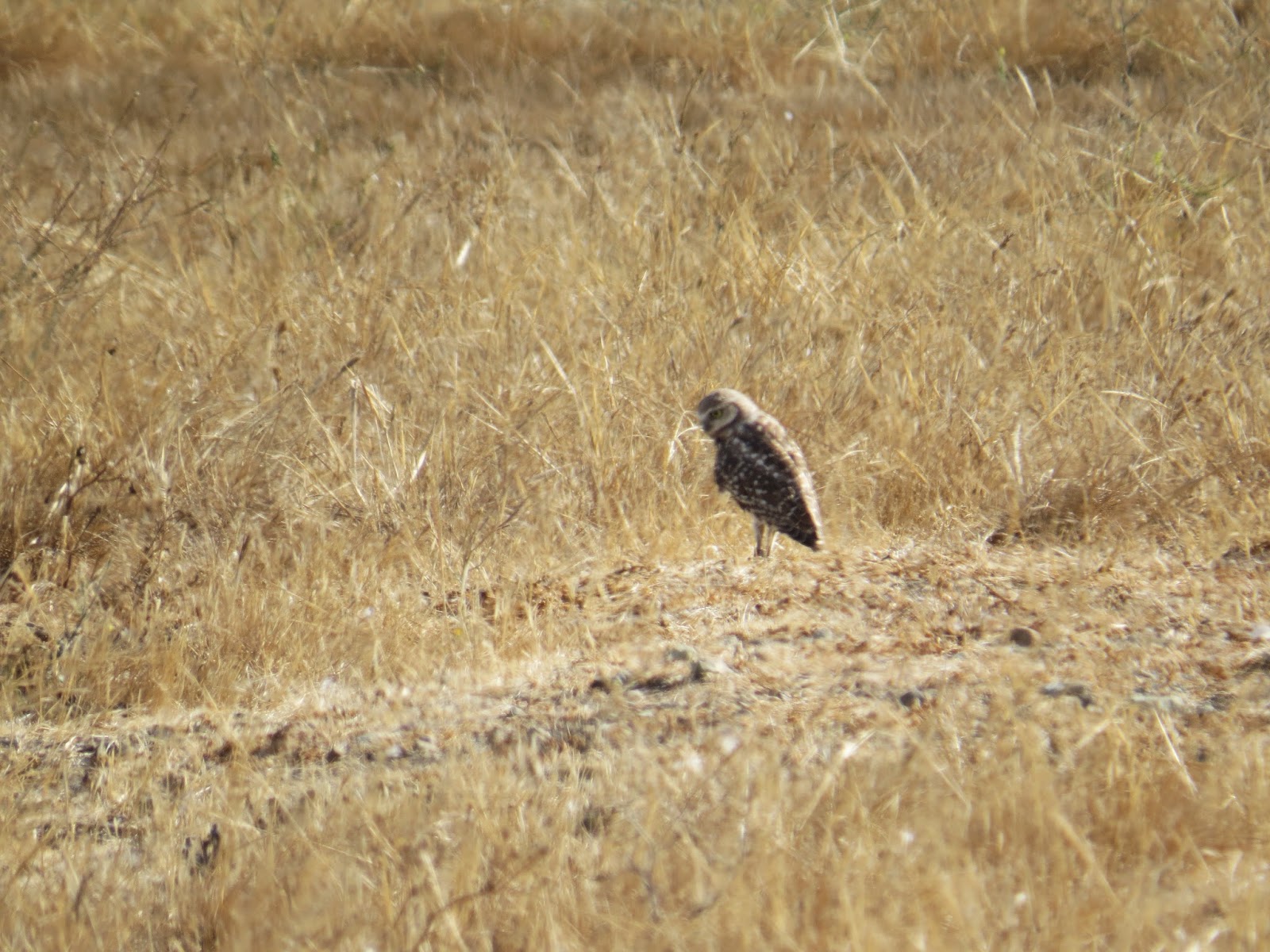
       It wasn't long before our dad shouted, "There they are!", pointing up the hill at two Burrowing Owls in one area, and four more in a different place, with at least one being an immature! It's great to see this threatened species still breeding, less than a mile from the headquarters of one of Silicon Valley's biggest tech companies! I managed to get some photos of the owls that weren't nearly as good as the ones in February. However, the last one clearly shows the banded leg of the owl - part of the conservation process being undertaken by the Santa Clara County Audubon Society (SCVAS).  


       In San Francisco, among other good birds, I found several Pygmy Nuthatches at both Land's End, and in Golden Gate Park, which were yearbirds. I could probably watch these little birds on the conifers, and listen to their squeaky twittering calls, for a really long time!


       That wasn't the only birding for the day... We went to the McAbee Entrance of Almaden Quicksilver Park once more in the evening! This time, we took our mom with us, to show her the owls and poorwills.

       We arrived a bit earlier than we had on the 16th, and set off down the same trail. The views of the sunset were stunning:


       We were at the place where I had gotten the poorwill photo, waiting for it to get dark enough for the owls to start calling, when, seemingly out of nowhere, we all heard a loud yipping and howling. I first thought it was just a person walking with his or her dog, but no one looked to be around. Then, my mom put forth the possibility that maybe a coyote was interacting with someone's dog far away (my dad had seen three coyotes farther down the trail on the day he had met Kurt and Eric Ongman). However, it soon became clear that there was no dog around.

       As soon as I had heard the coyotes, I immediately tensed up, and adrenaline pumped through my entire body. It was scary - I almost felt like one of my ancient ancestors, sitting in the dark, trying to fend off an inevitable attack of some unknown wild animal. I took out a dull pocketknife I usually kept when hiking, and my mom readied herself with her hiking stick. We saw several coyotes coming down the slope, and yelled to my brother and dad to come down.

       We saw a woman rushing down the trail, waving her hands over her head and screaming to discourage the coyotes from coming closer. Four of us cleared out pretty quickly, but my dad kept on lagging behind to listen for owls. As we moved down the trail, we heard the barking and howling of the coyotes echoing after us, but eventually getting quieter, and then completely dissipating.

        Almost at our car, the woman heard a rustling in the leaves near the trail. My dad shined his flashlight on the animal, and it turned out to be a California Kingsnake! It's the third time I've ever seen this snake, and what makes them really interesting for me is that they eat rattlesnakes! They're immune to their venom, and quickly grab the rattlesnake's head so it can't even open its jaws to bite.

       Later, safe at home, I looked up information on coyotes. In recorded history, there have only been two deaths from coyotes. Coyotes mostly attack little children that are left unattended, and are usually easily fended off with a walking or hiking stick. Their small size makes them a small threat, and they usually hunt alone (we saw a pack, though). Overall, I definitely overreacted. :) However, I'd rather not repeat this experience again, as some coyotes have rabies, and I wouldn't like being attacked by one in the dark, or encountering a mountain lion. Just a little reminder that nature can be dangerous, as well as pleasing and relaxing to be in.

* * *

       The next day, I decided to try to see a Wilson's Warbler - something I hadn't succeeded in doing during the spring. I chose the Los Alamitos Creek Trail, because I'd seen a Wilson's Warbler there last year in early August, and it was close to our house. 

       We parked on Winfield Blvd at around 11:00, and my dad and brother went jogging on the trail. The first bird I saw was a Nutmeg Mannikin, in a pepper tree right above the car! I'd seen these birds only once before (at the SCVWD last year). Even though they're technically ABA countable now, the Nutmeg Mannikin doesn't have a well-established population in our county, so the county birders have reached a general consensus that it shouldn't be counted in our county. Still, it was pretty cool to see this bird, which actually lives in tropical Asia, but was introduced in Southern California, and then expanded its range up here.

       Walking down the trail, the best birds I found were a female Black-headed Grosbeak eating elderberries, a Green Heron I accidentally flushed near the bridge, and a Bullock's Oriole. Farther down the trail, I met another birder, Steve, who showed me the same pair of birds - a subadult Brown-headed Cowbird being fed by a Pacific-slope Flycatcher - that I had seen in June. He told me that an interesting adaptation of the cowbird chicks was that they made generic baby-bird calls, to increase their likelihood of being "adopted" by an unsuspecting "mother". 

       I think that fall is coming earlier this year, with some of the trees' leaves already turning their autumn colors:


       On the way back, some of the best birds included several Ash-throated Flycatchers in the scrub to the right of the trail, my first observation of Western Bluebirds on the trail (also feeding on elderberries), and two Wrentits: one heard only, and one seen, and even photographed!


        Even though I didn't end up finding the Wilson's Warbler, I still had a great time, and saw some nice birds.

Summary:
Birds seen: 26
New birds: 0
Big year count: 173

* * *

       On Monday, the 21st of July, my dad and I went for a walk in Guadalupe Oak Grove Park, to watch the sunset and to try to find Western Screech-Owls. Bird-wise, the park was rather slow, except for a flyover Black-crowned Night Heron juvenile, but the sunset over the Silicon Valley from the hill in the park was stunning:


       At about 8:45, as we were completing our third circle around the park, when my dad thought he heard the trill call of the owl, but I didn't. We were already heading back to the car after a nice walk, when we both heard the owl much closer than last time. My dad played the call a couple of times, and I saw a dark shape swoop over us and land in an oak tree, for the second time this month. We took turns with the flashlight and my binoculars to look at the owl. It swooped from one tree to the other, and moving farther down the trail, we noticed another owl fly into the same tree as the first one! It's possible that this is a pair, and there is probably good habitat for nesting in this park, so it would be interesting to see if anything happens between the two owls.

       Before going to Southern California for a week, I would round off July with two trips - one to the Don Edwards National Wildlife Refuge Salt Ponds, and another to Salt Pond A2E near Moffett Field.

Good birding,

Sergey Pavlov


Monday, August 4, 2014

Over Mt. Hamilton!!

   I've been wanting to do this trip for so long that when I finally got a chance to, it seemed like a dream come true. I'd wanted to do this trip in May to catch the migrants in Joseph D. Grant County Park, but I couldn't find a weekend to do the trip, so I settled for this day. On Sunday, July 6th, my mom, brother, grandma, and I drove on Highway 130 through the Diablo Range before having to go to my brother's tennis match at 2:00. I was hoping to find birds like Wilson's Warbler and Western Wood-Pewee at Joseph D. Grant County Park, and specialty birds Lewis's Woodpecker and Lawrence's Goldfinch in San Antonio Valley. Here is the story:

        We arrived at Joseph D. Grant County Park at around 9:00 in the morning. A bit late, but not too bad, and I would soon find out that I wouldn't be disappointed with the birds I would see. It was already heating up, even though there was a slight breeze. We parked at the parking lot for Halls Valley Lake and walked the trail through the chaparral and oak savannah along the creek leading to the lake. During the 25 minutes we were there (we were on a strict schedule), we managed to see some pretty nice birds, both summer and year-round residents: a House Wren, two Warbling Vireos (really nice to see), two Ash-throated Flycatchers, several Western Kingbirds, a heard only Wrentit, and a White-tailed Kite.


       Halls Valley Lake offered more great birds. The island in the middle had at least three Green Herons, as well as a Great Blue Heron and lots of Red-winged Blackbirds. A Cooper's Hawk was cruising over the foothills to the east of the lake. A Killdeer, an early returning Western Sandpiper, and several young Song Sparrows were foraging on the mudflats at the edge of the lake. As I was about to walk back to the parking lot, I heard a high three-note call coming from a large oak. It took me awhile to find the bird making the call, but it turned out to be a flycatcher! I studied it closer, hoping for a Western Wood-Pewee, but after comparing the two in my field guide, I realized it was a Pacific-slope Flycatcher. Even though it was a very drab bird sitting in bad light, its primary projections and bill seemed short, the bird itself seemed small, and the call sounded much more like the Pacific-slope's on Cornell.


       In short, I was not disappointed with my stop at Halls Lake. Even though I didn't see any yearbirds, the birds I did see were amazing - I've rarely gotten to see such a variety in less than half an hour!

       We continued up Highway 130 (Mt Hamilton Rd.) for several more miles to the Twin Gates Trail. On the way there, we stopped several times to watch the Acorn Woodpeckers, White-breasted Nuthatches, and a photogenic Ash-throated Flycatcher in the surrounding oaks and grasslands.


       We didn't stop at the Twin Gates Trail for lack of time, and continued on to our next stop - Smith Creek Fire Station. Earlier in the year, this place is very good for migrants and summer residents, like warblers, vireos, and flycatchers. Key word - earlier. The middle of June was unfortunately too late for these birds, so I ended up seeing only one bird that wasn't a year-round resident - House Wren. The birders that were there several minutes before me didn't find anything of note except for the wren either.

       Now, the road really began to climb steeply, winding and employing switchbacks to take us up Santa Clara County's highest mountain. We stopped at several points on the road, but didn't find any birds. Here are the views from and of the road:


        As we drove farther up, the white dome of the the University of California's Lick Observatory loomed closer. We hoped to go inside once we reached the top of Mt Hamilton to see what had once been the world's second largest telescope.
        
       After about ten more minutes of driving, we arrived at the summit of Mt Hamilton. Finally, as I've dreamed about for almost a year, I could stand on one of the best vantage points for miles around and take in the entire southern San Francisco Bay Area. I could see almost everything - from the Santa Lucia Mountains near Big Sur in the south, to Loma Prieta, to downtown San Francisco and Mt Tamalpais in the north. Here is the Flickr set to the views from the summit, where I've labeled the major landmarks: https://www.flickr.com/photos/96975200@N08/sets/72157646097689971

       Unfortunately, the observatory opened in another hour, and we had to move on, so I just walked around the building. The only birds I found were a fledgling Dark-eyed Junco, an Oak Titmouse, and Turkey Vultures. There were also lots of dragonflies in the air. The vegetation up here was really different from any other place in the county, with oaks growing together with chaparral and coulter pines. Views from (and of) the summit:


       I would have stayed longer until the observatory opened, but we had to get to my brother's tennis match, so we moved on. From now, Highway 130 changed from Mt Hamilton Rd to San Antonio Valley Rd, which descend down the back of Mt Hamilton through a thick forest of coulter pines, and then takes us through San Antonio Valley into Alameda County. A quarter of a mile or so past the observatory, we passed Santa Clara County's highest point - Copernicus Peak, at 4372 ft (the observatory on Mt Hamilton was 4213 ft), on our left. Next time, I'd like to take the short trail from here up to the fire station to climb Copernicus Peak.

       Our minivan negotiated the windy road down the back of the mountain, going from the coulter pine forest to chaparral, and then to oak savannah. We stopped about five miles from the summit, where San Antonio Valley Rd crosses Isabel Creek.


       Getting out of the car, I heard birds calling from the the bushes near the almost dried-up creek. My first reaction was that they sounded like slightly wheezy Lesser Goldfinches, which got me running pretty quickly to the bushes. I managed to catch a glimpse of yellow wingbars on the otherwise gray pair of birds before they flew away. Lawrence's Goldfinches - my first yearbird (and lifer) of the day!

       A minute later, I refound the goldfinches on a snag, and even watched what looked like one feeding the other, making me suspect that one of them was an immature.


       After about 10 more minutes of driving, we stopped in the middle of a large expanse of chaparral. Here, the only birds were three Ash-throated Flycatchers. We continued on San Antonio Valley Rd, until it turned north into San Antonio Valley, and the chaparral was entirely replaced with oak savannah and woodland with hills rising on either side. The first birds I saw were several Yellow-billed Magpies, flying around and flashing their black and white plumage. It had been a long time since I'd seen these corvids (Ed Levin in April), and it was nice to see my second ABA code 2 of the day (Lawrence's Goldfinch being the other). Soon, my mom spotted a large bird soaring rather low over the valley, which turned out to be an immature Golden Eagle!

       As we neared the junction of San Antonio Valley Rd and Del Puerto Canyon Rd, I left the car for a bit to walk around to try to find the Lewis's Woodpeckers resident here. I came back empty-handed, but got some photos of the surroundings:


       At the junction, I got out of the car for the last time to walk around for five minutes - a last try for the Lewis's Woodpeckers. I checked every tree as fast as I could, but all I found from the melanerpes genus was an Acorn Woodpecker.
        I walked a bit down the road and heard House Finches from around the trees and bushes near the white building just south of the junction, as well as some other calls I didn't know. I finally located a bird sitting in a tree near me that was making the call. Looking at it through my binoculars, I saw a distinct dark facial pattern and a dark breast spot. Lark Sparrow! Another lifer and yearbird for today! Even though its a county code 2, I think it should be a 3 - the south and east county hills (like Santa Teresa County Park) are the best place for them, and I've never seen one there before today, and there aren't that many eBird reports in our county. It was nice to see this bird, because I wasn't sure I could get it later in the year, since I won't have much time to chase after tough birds like this.
        I returned to the car, and we continued in the same direction on Mines Rd without turning onto Del Puerto Canyon Rd for possible Canyon and Rock Wrens, and Greater Roadrunner. We drove on Mines Rd for about thirty more minutes until we reached Livermore, from where it took another thirty minutes to get to my brother's match in Fremont. We were only late by five minutes!
       Of course, not getting the Lewis's Woodpecker was a disappointment. I'll probably make this trip again in October to get the Lewis's Woodpeckers - they should be a good, easy addition to my list this year. If I don't see them in October, I'll most likely let them go - I can't afford to waste too much time on one bird, and the drive up and down the mountain isn't the easiest. Now, I'm happy that I managed to see the two yearbirds I saw

Summary:
Birds seen: 43
New birds: 2
Big year count: 170

Good birding,
Sergey Pavlov